A Probably Highly Neurodivergent Approach to Jigsaw Puzzles
Or, What I Did over the Winter Holidays

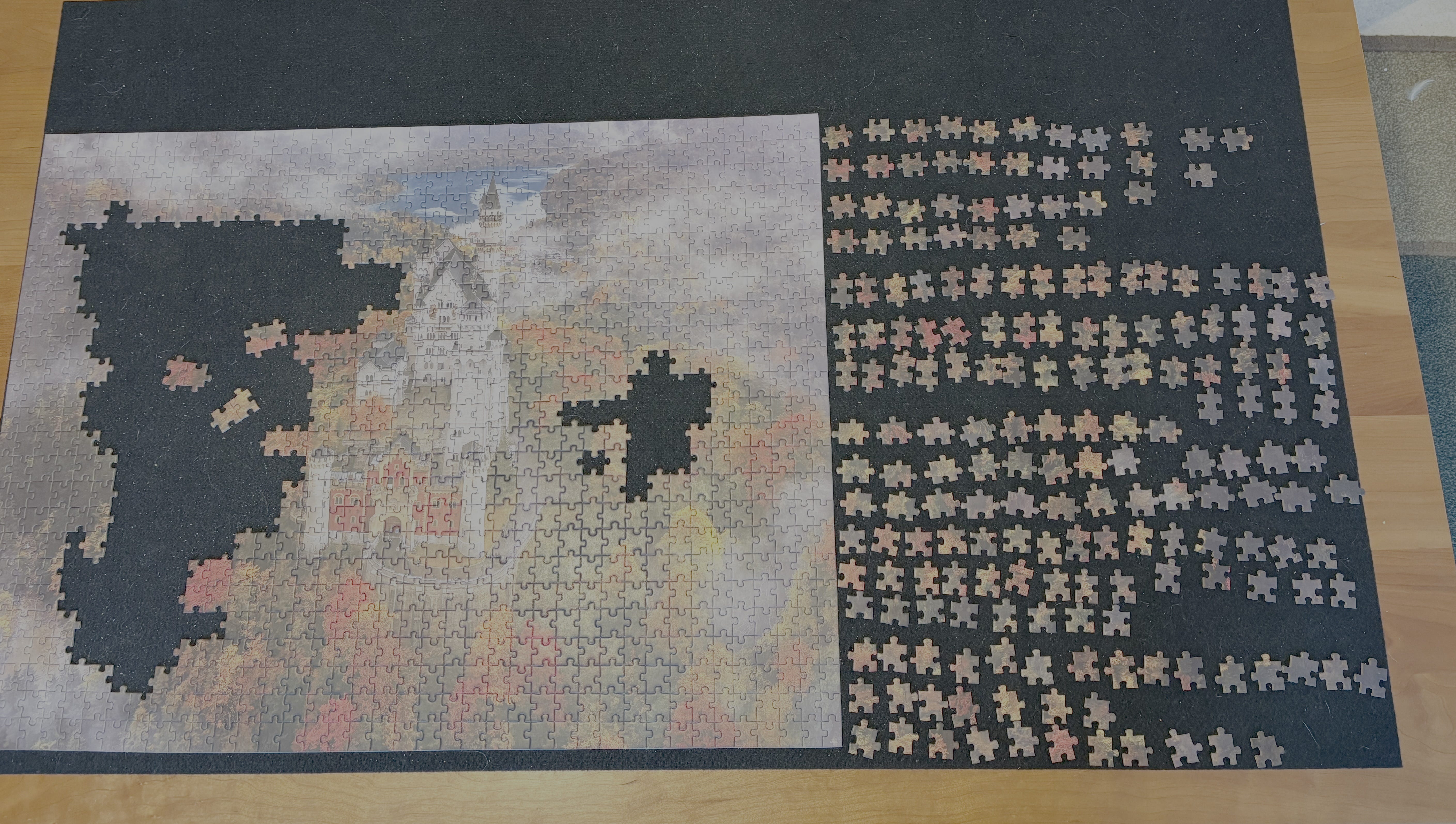
I like jigsaw puzzles a lot, but only in a set of very specific circumstances. (Anyone who knows me is laughing at the last half of that sentence.) To my mind, puzzles are for leisurely social occasions, probably in winter, for which there is no set timetable for things like meals or outings. Say, the day after Thanksgiving, Christmas Day, or the last week of December.
I have other essentials for an ideal puzzle situation. It needs to be well made out of solid cardboard that doesn’t split or peel. The art of the puzzle itself, whether photograph or illustration, needs to be aesthetically pleasing; who wants to stare at the minute details of something ugly for hours on end?
A thousand pieces is pretty much my sweet spot; smaller ones go too fast, and I don’t have room for anything larger. Some people like to redo puzzles, but I don’t; I’d rather give it away once I’ve completed it. (My brother belongs to a puzzle exchange in his area, which is a brilliant idea; maybe I should start one here in France.)
And ideally, I’m working on the puzzle with someone else. Maybe you’ve rented a chalet, and no one can agree on the appropriate movie marathon or board game. The point is, you’re with loved ones (or at least interesting ones) and you need something to focus on (that’s not a handheld screen) while conversation rises and falls in a natural rhythm. The social focal point could be needlework or crafting, but puzzles don’t require tutorials or directions.
Or do they?
Our family completed two and a quarter puzzles during the winter holidays while some of our children were visiting. Once my two most devoted puzzlers left and a third had to return to her schoolwork, I was left a lone woman in the jigsaw garden. This means that 25% finished puzzle languished on our coffee table for a couple of weeks, gradually gathering a bit of dust and corgi hair, as you can see in the photos.
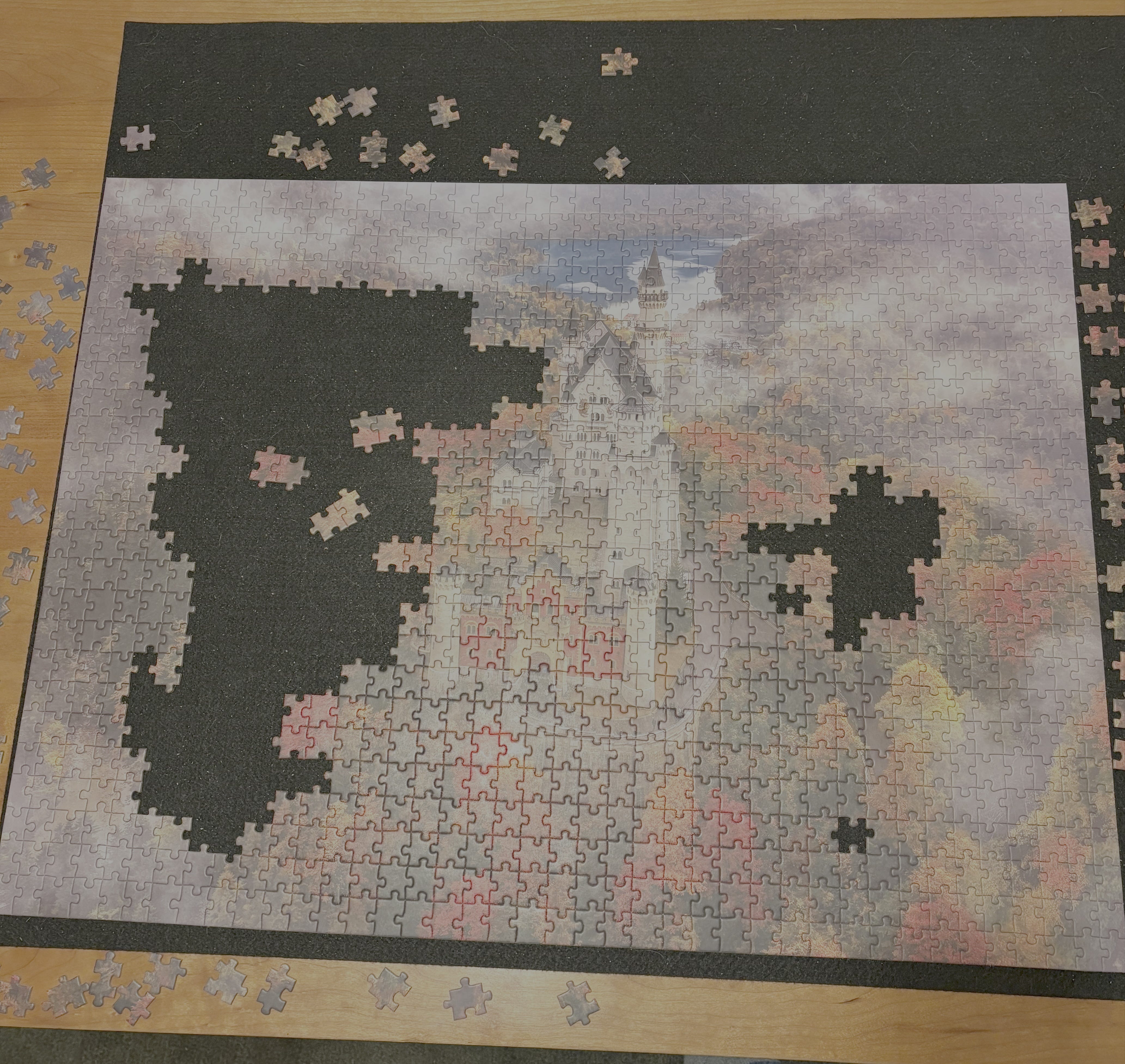
It was a hard one, too—perhaps the most challenging we’ve ever done—which made it all the more crucial to finish it, because I cannot admit defeat. I did buy a special puzzle felt roll so that I could move it if necessary, but when I thought about storing it at this point in the year, I knew it would probably sit in a closet for months, and that didn’t appeal. I decided to finish this third puzzle myself.
But in my 60th year, my eyes aren’t what they once were. Once we lose the best natural light in our living room—at about 1pm—or if it’s a cloudy day (very often this time of year), I’m forced to turn on the overhead light, and the glare means I can’t see the surface of the puzzle pieces nearly as well.
This means I’m forced to depend on the shapes of the puzzle pieces far more than on the picture printed on them. And to make any sort of headway on completing this bad boy, I had to fall back on a system I developed during the lockdown phase of the Covid pandemic when dealing with a challenging area of puzzle, like a sky, where the picture itself doesn’t give a lot of help.
Let me explain.
I’m a verbal learner, so I’ve named the puzzle shapes. In a typical puzzle, there are five basic puzzle shapes, which I’ll list from most common to least:
Classic (two heads on opposite sides, two scoops on the other sides;
Man (one head, three scoops);
Do-Si-Do (like a Man, but with one “arm” out and one scoop);
Key (three heads, one scoop); and
Greek Cross (either scoops or heads on all four sides).
Each of those can be broken down into two main subtypes: Tall and Short.
Then I add other differentiators, for example, fat or skinny; big or small head, arms, legs, or scoops (the holes/indentations); symmetrical or asymmetrical, etc. For the Men, I sometimes call their feet spades, but only when they’re pretty square. I don’t know why; it just came to me.
So to make headway on a big area with not a lot of help picture-wise, I figure out how to fill one particular spot—and then I describe it to myself verbally. Maybe it needs a short, asymmetrical Key with one especially small head of the three; or it could be a tall Classic with symmetrical scoops. Describing the piece helps me when I’m scanning the pieces and keeps me from getting distracted, which is a significant risk.
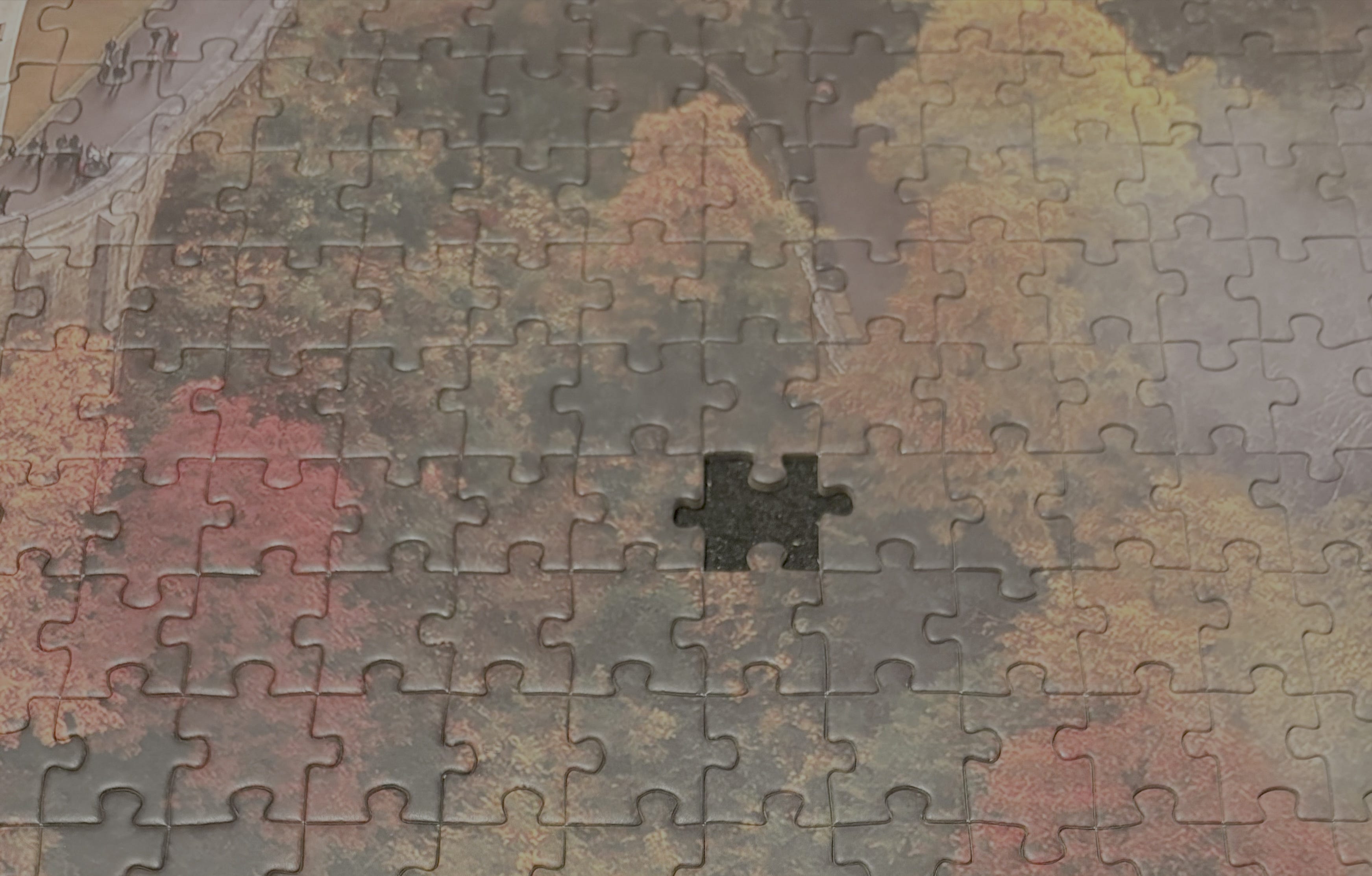
At a certain point (like in the photos, when I was driven solely by desperate completion anxiety), I arrange the pieces by type and subtype (see the photo at the top of this post). Grouping them by color helps, too.
Obviously I don’t always know exactly what shape I’m looking for. If only one side of four is defined, it could be almost any of them. With two sides defined, you can fall into the trap of thinking you’re looking for a Classic, when it could actually be a Man or a Do-Si-Do that you need. Remind yourself periodically of the other options you might be missing.
Then it’s just as simple as Bend and Snap: Name and Fit.
You can see I have another rule: no single pieces within the frame at any time. This helps eliminate visual clutter.
Badda bing, badda boom: the puzzle is done.
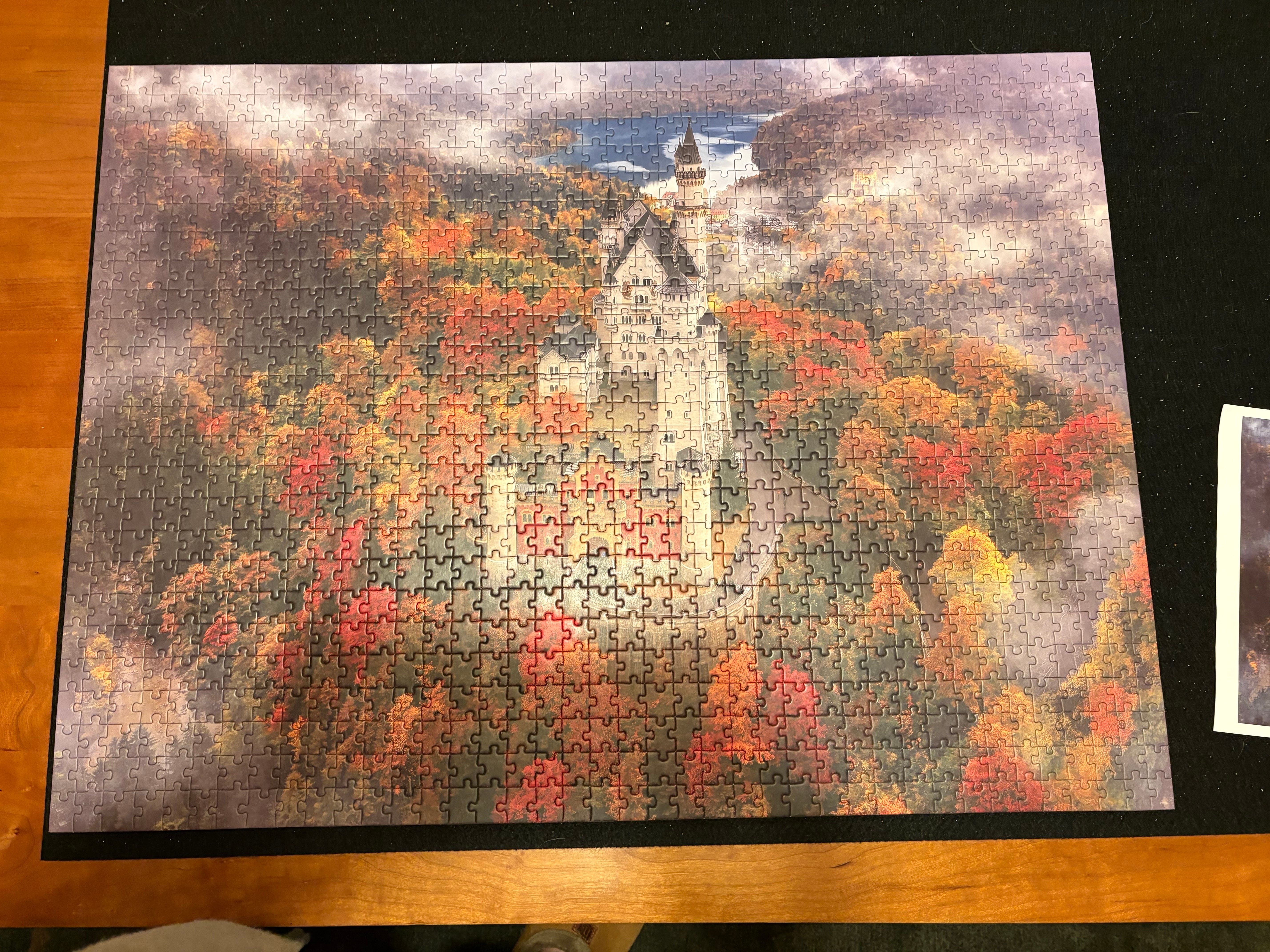
Now I’ll give this puzzle away and wait for our next social occasion to get started on the next. Maybe I’ve reinvented the wheel. I know competitive puzzlers exist, and they likely have systems very like mine. They must, right? But I kind of don’t want to know.
Loved this.
Great advice on the shapes!