Compassionate Productivity
Most habit trackers burn me out. Not this one!

Originally published on Medium on 23 September 2023. I’ve updated it as of today.
I’m a big fan of trying to get things done. I’ve written before about different motivational tactics, like my carnet (my notebook system) and Opposite Action. My BFF and accountability partner Annette Lyon and I wrote a whole book on different strategies we’ve used over the years to set and accomplish goals.
Like many people, I have to-do lists for any given day, but it can get tedious to rewrite the things we want to do every day over and over again. As a result, someone much smarter than I am came up with the idea of the habit tracker. I used to make classic BuJo habit tracker graphs for each month, which work really well for a lot of people.
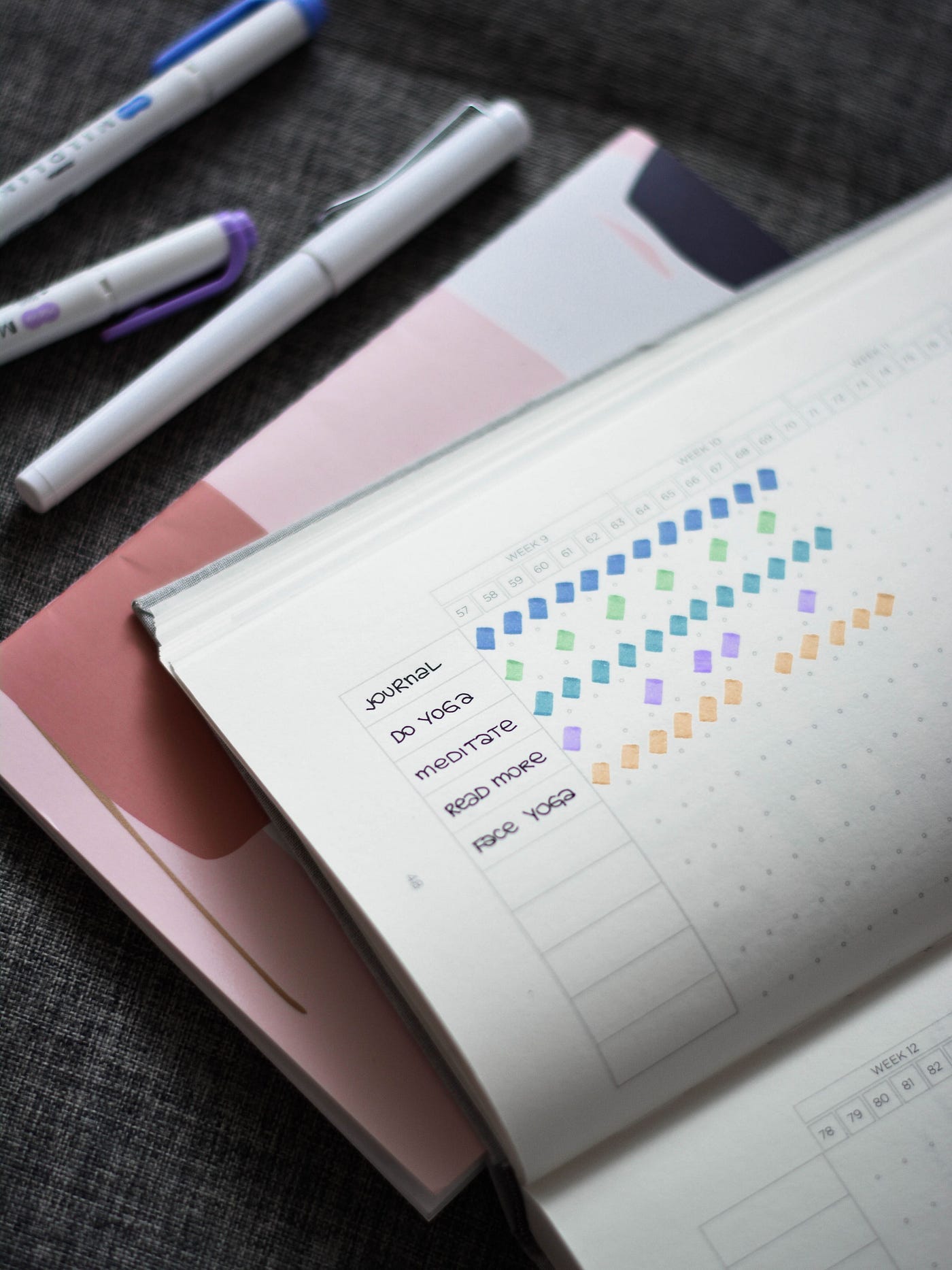
But a few things got in my way when I used graphs for habit tracking. First, they take some time to set up. Now, I really admire people who make their notebooks beautiful, but I’m not that gifted an artist, and when it comes to spare time, I’d rather be reading or knitting or making music.
Second, sometimes the graphs made me feel a lot of pressure to keep a streak going, and then my pathological demand avoidance would kick in, and I’d rebel.
Third, once my streak was broken, the “all or nothing” piece of my personality would kick in, and I’d be less motivated to track anything at all.
But then, with a little help, I developed a new approach. In the wonderful book One Small Step Can Change Your Life, Robert Maurer presents the Japanese concept of kaizen, which is a method of creating significant and lasting change through the smallest of steps. If you haven’t run since high school P.E. class, but now want to attempt a marathon, Dr. Maurer suggests starting far smaller than perhaps you think is necessary. Your initial goal shouldn’t be to run a mile per day, or even a half mile.
Instead, you have to decide what the smallest step is that you know you can take, that you won’t be tempted to procrastinate — and that might be as small as just setting your new running shoes next to your bed, or putting on exercise clothes when you first wake up. Once you’ve accomplished that, you’ve won.
Because we humans tend to daisy chain actions, you might feel like walking around the block once you’re dressed for it. Once you’ve walked a block, you might walk (or run) another. But the important thing is that you achieved your minimum goal, which you need to celebrate. This is the compassionate piece of compassionate productivity. Don’t let some crazy ideal of perfection (and I’m talking to myself) be the enemy of the good.
Minimum goals obviously change once we’ve established habits — but then life can happen, and a habit can get derailed. There’s nothing wrong, then, with going back to those minimums and rebuilding momentum.
My accountability shorthand for “kaizen-ing” a daily habit is “J10,” meaning “Just Ten Minutes.” You may have all kinds of things you want to accomplish or improve that could benefit from a kaizen approach, everything from journaling to meditation to writing a novel. Currently, I have seven things I try to do every day for my mental, physical, and spiritual health:
Writing
Scripture Study
Yoga
Walking the Dog
Piano Practice
Mandolin Practice (Was Organ Practice when I first wrote this.)
French Study
My ideal time goals for each of these activities vary. I try to walk the dog for at least 45 minutes, and I do these amazing yoga videos that run about 75 minutes each. I’d ideally like to write for four hours a day (but sometimes one hour is all I can muster).
I’ve learned, though, that to avoid burnout, I need to keep my minimum quite low. Obviously, an hour-long walk (or an hour on the mandolin or studying verb conjugations) is optimal, but just ten minutes is far better than zero.
Just ten minutes a day of any activity adds up. That’s 60 hours in a year. Would you be better at anything if you studied or practiced it for 60 hours? Absolutely you would.
Some days, I can have a lengthy walk with the dog and spend a long time reading scriptures, but then something comes up, and I need to J10 piano practice. That’s okay. Some days, I have a doctor’s appointment or a kid’s water polo game, and I have to J10 my French study. No problem. Sometimes, I get so caught up in writing that I lose track of time and have to J10 most of the rest of the list. Totally fine. I still get credit for it if I spend just ten minutes on it.
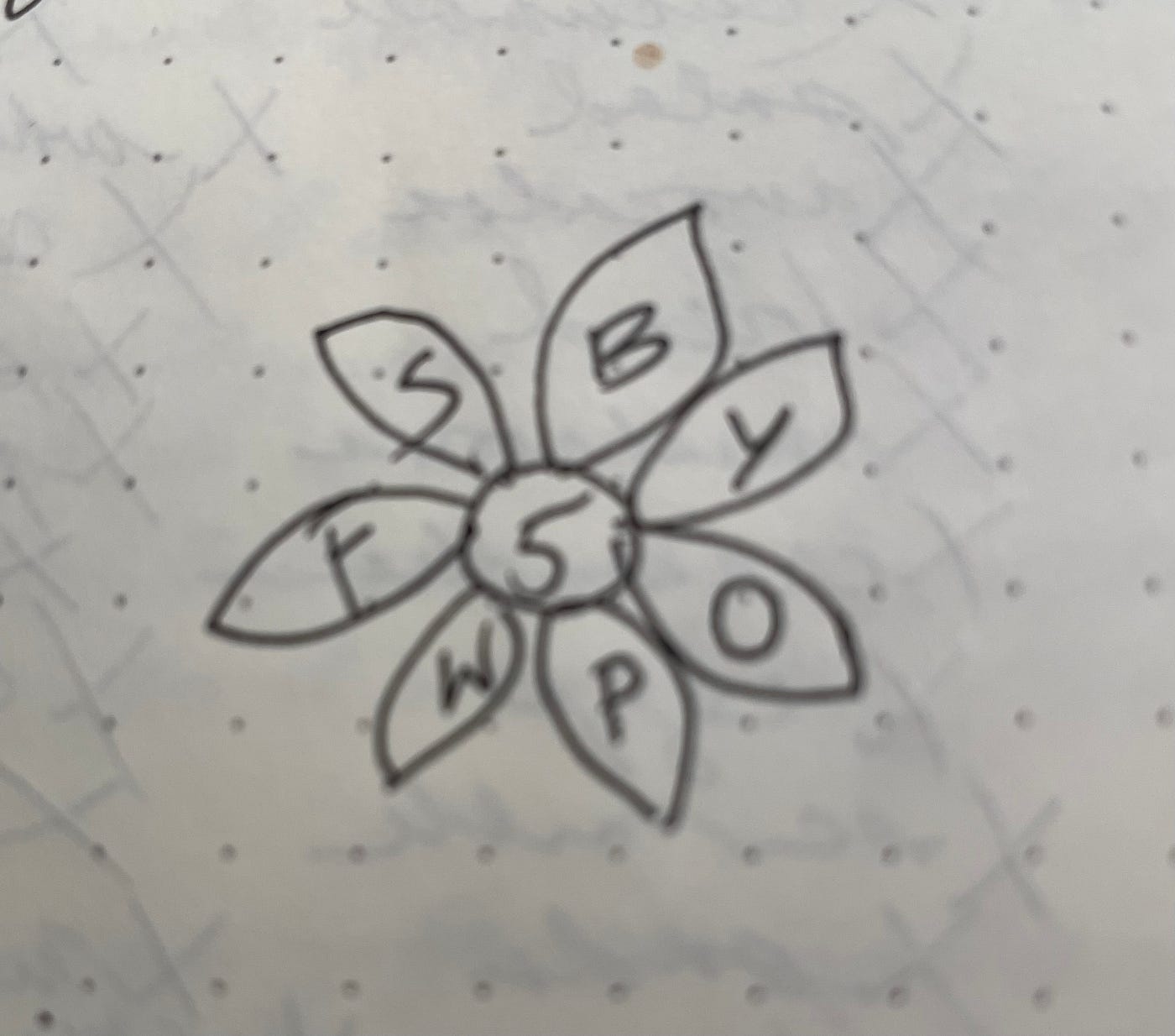
As for tracking things, I needed something with a “just for today” vibe that wouldn’t put streak pressure on me. For my carnet/notebook, I came up with a little flower, pictured at the top of the article. In the center is the day’s date. Each petal stands for an activity. (“B” is for “balader,” a French word meaning to take a walk. I use “B” because “W” is for “writing.”)
In the morning, I make a little circle with the date inside. As I complete an activity, I draw a petal and label it. Since I started this system, I haven’t achieved a seven-petal flower every single day; some days have had as few as three. But I do have a record of things I’ve done, I haven’t felt burnt out or pressured, and I know the time spent on them will accrue to my benefit. By all accounts, I’m succeeding.
How do you track your habits? Do you think the J10 Daisy might work for you? Let me know in the comments!
Whenever I read stuff you write I always think "She is SO SMART WHY CANT I BE SMART LIKE LUISA??" But now you've revealed your tricks, and I'll use your productivity method, and soon I'll beat you at your own game!
“Just ten minutes” beats perfect systems every time. Momentum doesn’t need pressure, it needs permission. 🌱